Kingston Flemings - 2026 NBA Draft Scouting Report & Projection

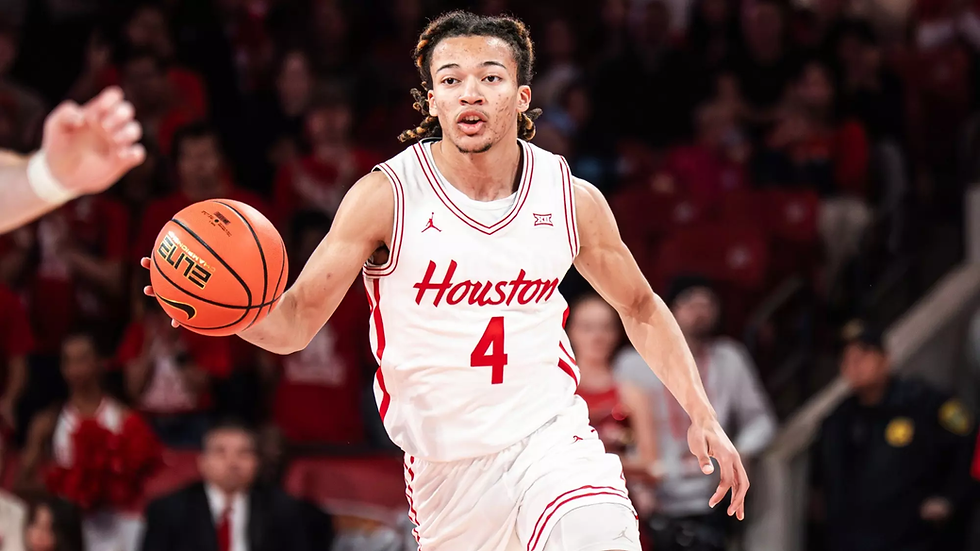
Kingston Flemings — Scouting Report & NBA Projection
6’3.5” | 183.4 lbs | 6’3.5” WS | Point Guard
Draft Age: 19.5
Executive Summary
Kingston Flemings projects as a smart, skilled, pass-first point guard whose best NBA value should come from high-level passing and pick-and-roll orchestration, quick processing, and competitive team play rather than from star-level self-creation. He was the offensive driver for a methodical, defense-oriented Houston team and consistently created value with his decision-making, shotmaking touch, and overall feel.
The issue is that his physical profile likely places a hard cap on the upside. He is small by NBA standards for a lead guard, lacks strength and length, does not generate enough easy rim or three-point offense, and may struggle more on defense in playoff settings than his college impact metrics suggest.
Projection: Good NBA rotation guard with a clear pathway to positive offensive value.
Translatable Skills
Elite pick-and-roll passing
Quick processing
Pocket passing
Ball movement
Midrange shotmaking
Good shooting touch
Competitive team defense
Defensive rebounding for position
Scrappiness / effort
High feel / IQ
Vertical athleticism
Good free throw touch
Questionable / Limited Translation
On-ball scoring ceiling
Rim finishing
Three-point volume
Blow-by ability against quality defenders
Off-ball offensive activity
Isolation defense
Switch defense
On-ball screen navigation
Defensive value against physical NBA matchups
Role Projection
Primary role: Point guard
Offensive role: Secondary creator / table-setter
Defensive role: Team defender with regular-season value, but playoff vulnerability
Flemings projects best as a smart offensive connector who can run pick-and-roll, make fast reads, keep the ball moving, and create value for better scorers and rolling bigs. He can score enough to be respected, but the profile is more “good offensive player in the right context” than true offensive driver.
Best optimized next to a strong pick-and-roll big and lineups with enough physical size around him to protect his defensive limitations.
Statistical Indicators
26.5% usage / 56.3% TS → decent efficiency at real volume, but not exceptional
11.4 BPM / 6.3 OBPM / 5.2 DBPM → elite overall impact and strong two-way signal
Top-10 RAPM → elite overall influence
Houston offense much worse without him → clear offensive driver
32.6% AST / 13.1% TOV → excellent passing efficiency
57.2% at rim on 166 attempts → good volume, but weaker efficiency than you want
44.3% on 194 midrange attempts → very strong accuracy, but too much diet there
38.7% from three on 106 attempts → clearly positive shooting signal, but volume needs to rise
84.5% FT → great touch indicator
1.3% blocks / 3.0% steals → excellent defensive playmaking for role
Good defensive rebounding
Low FTR (27.7) → not getting enough easy points at the line
Team context matters:
Houston played extremely slow
Houston was defense-first
Houston rarely emphasizes freshman guards
Houston forced a lot of turnovers
Houston did not play much in transition
Houston did not have a strong three-point rate
That context strengthens the case that Flemings was doing real halfcourt work and not relying on transition. It also helps explain why the steal rate may be somewhat environment-aided and why the three-point volume may have been artificially low.
Film Evaluation
Offense
Scoring
Flemings is a patient operator who understands how to play within an offense, attack matchups, and get to his preferred spots. His most comfortable scoring zone is the midrange, where he can use deceleration, vertical lift, and touch to rise into pull-ups. That’s a real skill, and he hits those shots at a strong clip.
He can also pull from deep and has enough confidence to shoot against unders. The touch is clearly there. The problem is that he does not create enough of the best shots. He does not get enough threes up, and he does not finish well enough at the rim to lead an offense as a star level guard.
He can beat weaker defenders, especially when the defense is already shifting. But against better defenders, the limitations show up more clearly. He often needs multiple moves to get separation, struggles to fully shred elite on-ball defenders, and tends to settle for the midrange .
Rim Pressure / Finishing
Flemings can get into the paint, but he is not a great downhill guard. He does not have elite burst by NBA standards and is often derailed by bumps on the way to the rim because of his lack of strength. He is a very good vertical athlete, and that certainly shows up on dunks and occasional tough finishes, but it does not fully solve the issue.
His rim finishing is one of the biggest swing skills in the profile. He gets there well enough, but he does not convert efficiently enough, especially against better competition (statistical analysis supports this point too). He is not someone who reliably generates easy scoring through pure force or pure speed.
Passing
Passing is the best part of Kingston's game.
Flemings is a near-brilliant pick-and-roll (and outside of the PNR too) passer who:
makes the right read instantly
excels against traps, hedges, and blitzes
throws excellent pocket passes
manipulates defenders well
finds the short roller quickly
keeps vision alive while driving
pushes the ball ahead smartly
He is extremely unselfish and clearly has true point guard instincts. He consistently makes the correct play, rarely hesitates, and understands how to create value even when he is not beating defenders cleanly. His feel is elite and undeniably gives him the potential for bigtime NBA value.
Off-Ball Value
This is more of an open question.
He plays off the ball a fair amount, but he does not do much with it right now. There are flashes of relocation, but not enough. He is not especially active as a mover, and the profile would benefit a lot if he embraced more off-ball utility.
That matters because if he is not going to be a true offensive driver, then secondary offensive value becomes more important. However, given his intelligence and team friendly game, it is fair to anticipate that Kingston will ultimately find ways to bring off-ball value.
Transition
Houston rarely played in transition, so this part of the profile is underexposed. There is no strong reason to think Kingston will be bad there, but also not much evidence that transition will become a major NBA value source.
Defense
On-Ball Defense
This is where the projection gets shaky.
Houston often deployed Flemings in a way that let his off-ball activity and defensive playmaking show up, but it also reduced how often he had to guard strong offensive players one-on-one. When he was stress-tested in isolation or in more direct on-ball situations, the results were often concerning:
gets moved easily
struggles with strength
bad on-ball screen navigation
shaky switch defense
can be overpowered by bigger guards and wings
The physical profile is a real problem here. He is small, skinny, and lacks length by NBA standards. That matters a lot in modern playoff basketball, where weak defenders are hunted repeatedly in switches and isolation.
Off-Ball Defense
This is where Flemings earns his positive defensive reputation.
He is:
active
smart
competitive
aggressive as a helper
disruptive in the gaps
very willing to rotate
a good tag defender
a very good rebounder for his size
capable of making playmaking events as a guard rim protector
He genuinely cares on this end, and that shows up. He plays hard, fights for loose balls, rebounds out of his area, and makes timely rotations. The instincts are real.
The question is whether those strengths are enough to create positive aggregate NBA defensive value once the on-ball and physical weaknesses are stressed more consistently.
Rebounding
Rebounding is a positive. He competes, boxes out despite his size, high-points the ball well, and plays with real effort on the defensive glass.
Physical / Athletic Profile
Quickness: Okay by NBA standards
Strength: Poor
Explosiveness: Very good vertically
Coordination / fluidity: Good
Lateral agility: Okay, not special
Length: Poor for an NBA point guard
This is the heart of the projection.
Flemings is not physically overwhelming enough to drive star outcomes. He has real vertical athleticism and good overall coordination, but the lack of strength and length show up clearly on both ends.
Context (Houston)
Flemings was a freshman starting guard for Kelvin Sampson, which is meaningful in itself. Houston is not a program that casually hands major roles to first-year guards, especially not ones who are not physically dominant. The fact that he started every game and became arguably Houston’s best player is a real signal for talent, maturity, and trustworthiness.
Houston was:
5th overall
15th on offense
3rd on defense
extremely slow
turnover-forcing and hyper-aggressive defensively
That context matters. It highlights how much real value Flemings added offensively, but it also means some of the defensive playmaking numbers may be system-enhanced.
Durability / Character
Durability / Injury History
No known major injury or durability concern based on public reporting. Flemings handled a full freshman workload at Houston without any clearly reported significant absence or chronic issue.
Character / Behavior / Intangibles
No known off-court or behavioral concerns. Public reporting paints Flemings as humble yet confident, unselfish, coachable, and team-first, with strong evidence of maturity and fit inside Houston’s demanding winning environment. He presents as cerebral, engaged, and highly professional. I've watched Kingston break down tape and was very impressed by his intelligence and humility.
Overall Evaluation
Offense
Flemings should be a good offensive player in the NBA, but I do not project him as the best offensive player on a good offense.
He does not create enough easy scoring opportunities. Too much of the scoring package currently lives in the midrange, and he does not generate enough high-leverage rim and three-point attempts to project as a star offensive engine. He also does not have the physical tools to reliably dominate good defenders one-on-one.
Still, the passing is exceptional, the touch is real, and there is enough shotmaking here that he should return good offensive value and could provide outlier value in the right context.
Defense
Flemings’ defensive value is complicated.
He should create positive plays through rebounding, rotations, deflections, and general team defense. But the physical limitations are serious, and they matter most in the areas that get stressed hardest in playoff basketball: on-ball defense, switches, and isolation. That creates a real risk that the regular-season defensive value looks better than the playoff defensive value.
Overall, I would project him as neutral to slight negative defensively rather than confidently positive.
Final Projection
Good rotation guard with clear offensive utility. High-feel point guard whose passing should translate. Physical limitations likely cap the upside


Comments